




















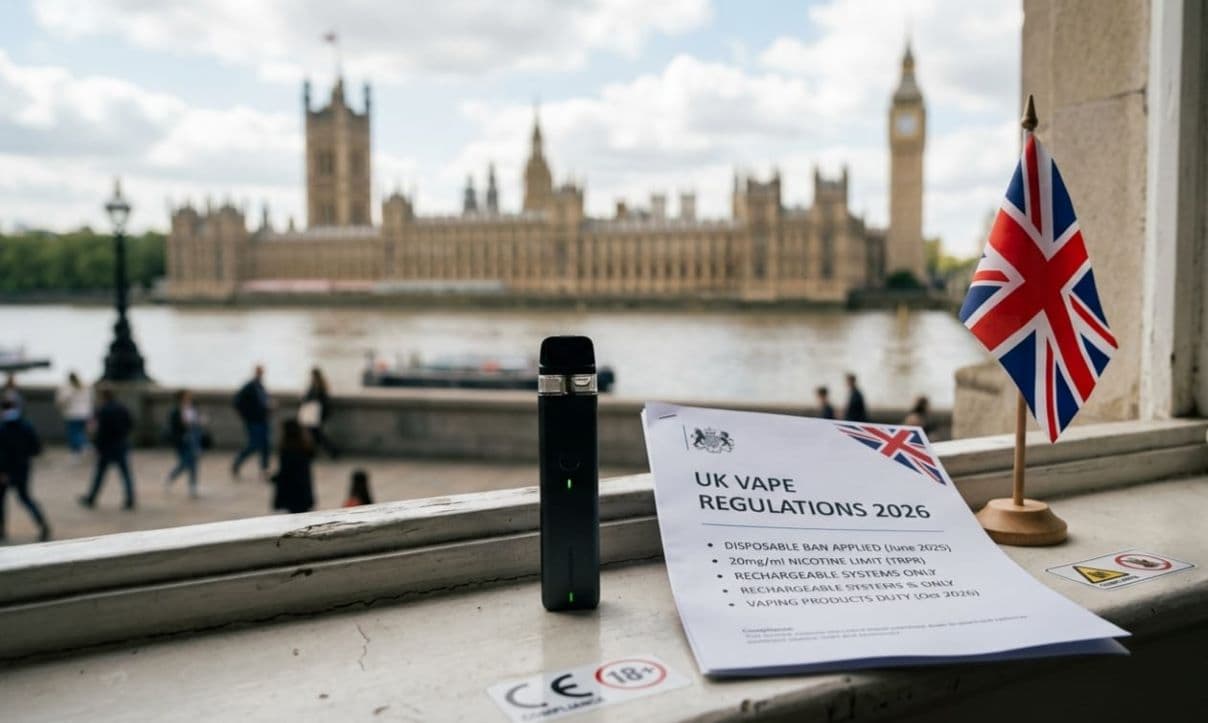
The United Kingdom's vaping landscape changed more significantly in 2026 than in any year since e-cigarettes first entered mainstream use. A generational tobacco ban passed into law. Disposable vapes were banned nationwide. A new vape duty tax confirmed for October 2026. And the government acquired sweeping new powers over flavours, retail licensing, and advertising.
This guide covers exactly where UK vaping law stands right now — what is banned, what is still legal, what is changing, and what every vaper in England, Scotland, Wales, and Northern Ireland needs to know.
The Foundation: Three Pillars of UK Vaping Regulation
UK vaping law in 2026 rests on three regulatory pillars that operate simultaneously.
Pillar 1 — TRPR (Tobacco and Related Products Regulations 2016): The product-level foundation. Covers nicotine strength caps, tank and bottle size limits, packaging requirements, and MHRA notification. Every legally sold vaping product in the UK must be TRPR-compliant.
Pillar 2 — The Tobacco and Vapes Act 2026: Received Royal Assent on 29 April 2026. Introduced the generational tobacco ban, disposable vape prohibition, new advertising restrictions, and a retail licensing scheme with real enforcement teeth. Trading Standards officers can now issue on-the-spot fines and confiscate illegal stock without a court order.
Pillar 3 — The Vaping Products Duty (October 2026): A new excise tax of £2.20 per 10ml of e-liquid — including nicotine salts, freebase, shortfills, nicotine shots, and prefilled pods — takes effect on 1 October 2026. VAT applies on top, bringing the real-terms increase to approximately £2.64 per 10ml. Hardware is not affected.
The Disposable Vape Ban: Already in Force
The single most significant change to the UK vaping market in recent years is already law. As of 1 June 2025, selling or supplying single-use vapes is illegal across England, Scotland, Wales, and Northern Ireland.
What Is Banned
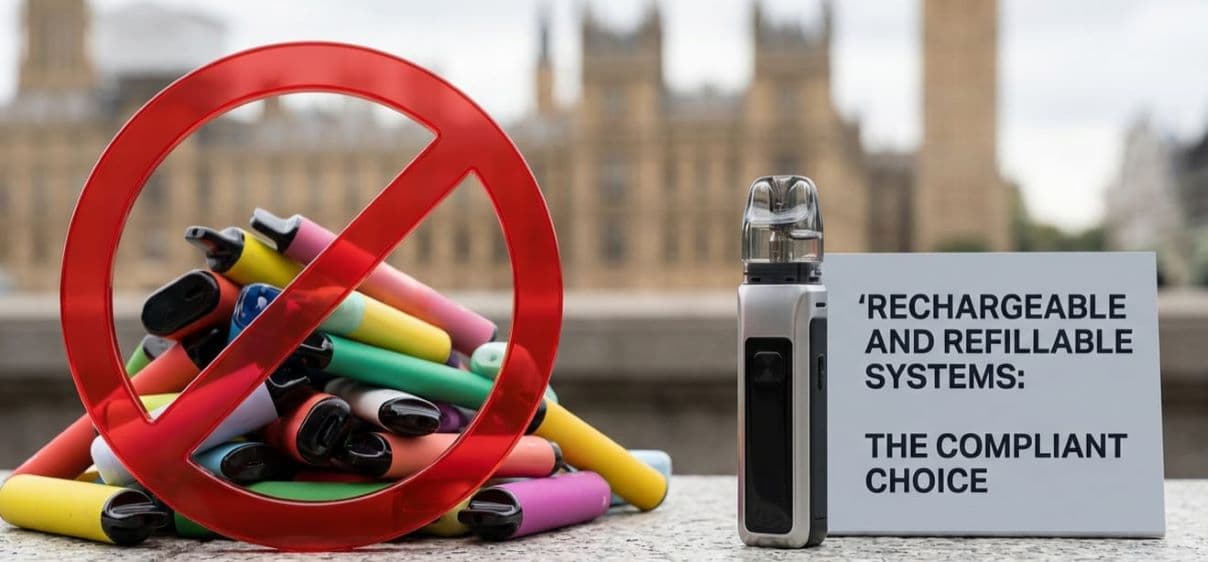
Any disposable vape — a device with a non-removable, non-rechargeable battery and pre-filled e-liquid that is discarded when depleted — is illegal to sell or supply. This includes all major disposable brands that previously dominated UK retail. The disposable vape ban took effect on 1 June 2025 across England, Scotland, Wales, and Northern Ireland.
The ban was driven by two concerns: youth vaping rates and environmental damage. 1.3 million disposables were being discarded weekly before the ban, each containing a lithium battery and non-recyclable plastic components.
What Is Still Legal
Only disposable vapes have been banned. Refillable vape kits and prefilled pod kits with swappable pods are still legal. If the battery is rechargeable and the pod is replaceable, the device is compliant. Prefilled single-use pods have been proposed for future restriction but are not yet banned.
Age Restrictions: Two Different Rules for Two Different Products
The Tobacco and Vapes Bill received Royal Assent on 29 April 2026, making it illegal anywhere in the United Kingdom to sell tobacco products to anyone born on or after 1 January 2009. This generational cutoff means no one in that birth group will ever reach a legal age to buy tobacco, regardless of how old they get.
Vaping is different. Vaping products and nicotine products are not subject to the generational ban. Instead, they carry a standard under-18 age restriction. It is an offence to sell a vaping product or nicotine product to anyone under the age of 18. Once a person turns 18, they can legally buy vapes and nicotine products regardless of birth year.
A 19-year-old born in 2009 cannot buy cigarettes or rolling papers but can buy an e-cigarette. Retailers must understand both rules because a single ID check serves two different legal tests depending on what the customer wants to buy.
Retailers follow the Challenge 25 industry practice — anyone who looks under 25 is asked for ID. The age restriction extends to online sales, requiring digital ID verification systems.
Product Rules: Nicotine Limits, Tank Sizes & TRPR Compliance
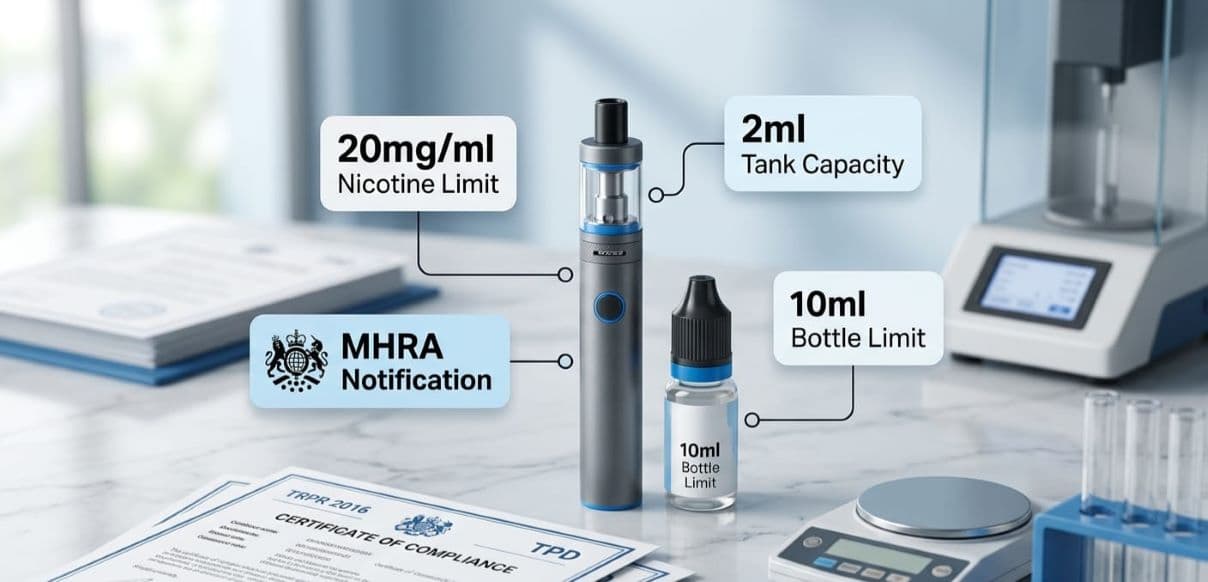
Nicotine strength in e-liquids is capped at 20 mg/ml. Refillable tank capacity is limited to 2 ml, and nicotine-containing bottles are restricted to 10 ml.
These TRPR limits apply to every product sold through legitimate UK retail channels regardless of where it was manufactured. A product that is legally sold in the USA or Korea at 50mg (5%) nicotine cannot be legally sold at that strength through UK retail — the 20mg/ml (2%) cap applies.
MHRA Notification Requirement
Every nicotine-containing vaping product must be notified to the MHRA (Medicines and Healthcare products Regulatory Agency) before it can be legally marketed in the UK. The MHRA oversees product notifications and ensures that vape products meet strict safety and quality standards before being sold legally.
A TPD-compliant product has been tested, notified to the MHRA, and meets the legal standards on nicotine strength, bottle size, tank capacity, packaging, and labelling. If you are buying from a legitimate UK retailer, the products on sale should all be TPD compliant.
Shortfills and Nicotine Shots
The 10ml bottle restriction on nicotine-containing liquid led to the shortfill format — large bottles of nicotine-free e-liquid with space left for a nicotine shot to be added by the consumer. Higher strengths are available for personal import, but cannot be sold through domestic retail above 20mg/ml.
The Vape Tax: October 2026
From 1 October 2026, a new Vaping Products Duty adds £2.20 per 10ml to all e-liquid, including nic salts, shortfills, nicotine shots, and prefilled pods. VAT is applied on top, bringing the real-terms increase to around £2.64 per 10ml. Hardware is not affected.
To maintain the price gap between cigarettes and vapes, tobacco duty will also increase by £2 per 100 cigarettes when the vape tax takes effect.
Even with the tax, vaping remains significantly cheaper than smoking. The government's position is that the tax closes a pricing gap that made vaping disproportionately appealing to non-smokers and young people while preserving the cost advantage for adult smokers using vaping as a cessation tool.
Flavours: Still Legal, But Under Regulatory Watch
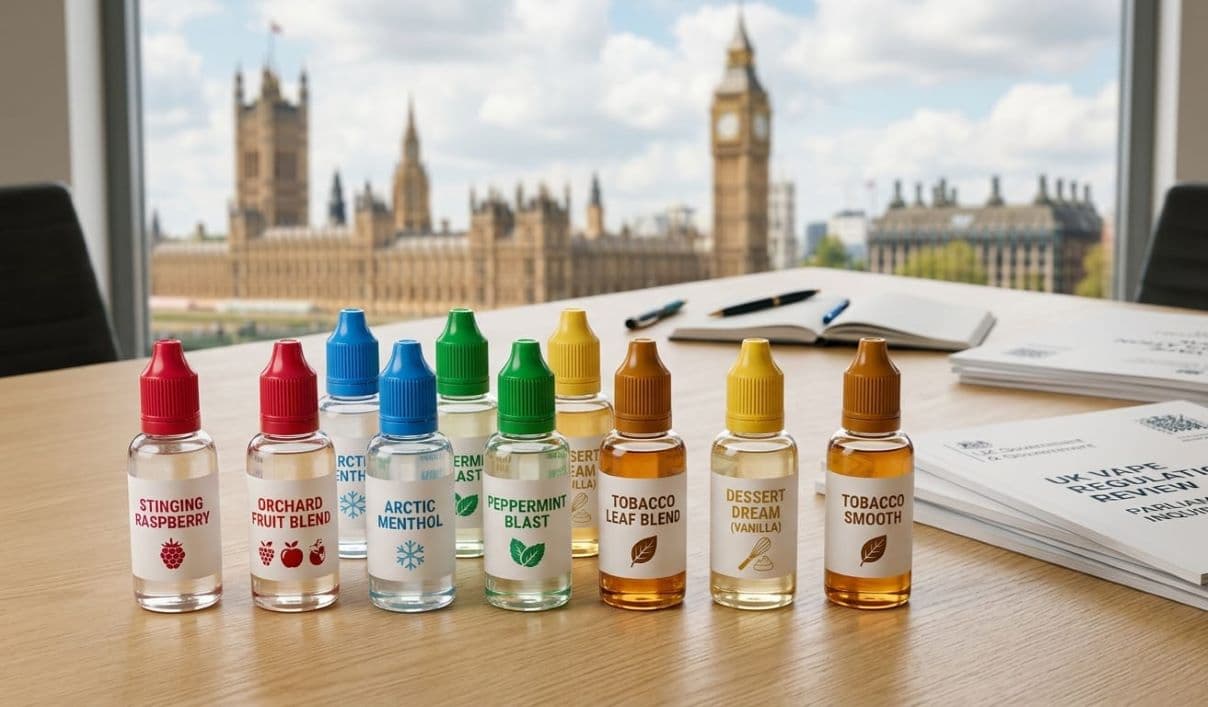
Refillable kits are legal, flavours are intact for now. This is one of the most important distinctions between the UK and markets like the USA or several US states where fruit and menthol flavours are banned.
The Tobacco and Vapes Act 2026 gives powers to regulate flavour names and descriptions, but those powers need secondary legislation and a public consultation before they become law. Fruit, dessert, and menthol e-liquids remain fully legal today. The consultation process means any change sits months away at the earliest.
If restrictions do come, they are expected to target child-appealing naming conventions — flavour names like "candy", "bubblegum", or "gummy bear" — rather than banning entire flavour categories. The direction of travel is naming reform, not outright flavour prohibition. No confirmed changes as of mid-2026.
Where You Can and Cannot Vape in the UK
There is no national indoor ban, but private businesses and venues can set their own rules.
Transport: Most public transport operators — including TfL buses and trains, National Rail, and the London Underground — prohibit vaping. Check individual operator policies before travelling.
Hospitality: Pubs, restaurants, cafes — most prohibit vaping; some have outdoor areas. There is no universal rule; each venue sets its own policy.
Workplaces: Most UK employers prohibit indoor vaping. Designated outdoor areas are common in larger workplaces and public buildings.
NHS premises: Vaping is generally restricted on NHS trust grounds, though some trusts permit it in designated areas as part of their smoking cessation support policy.
Outdoors: No general restriction on outdoor vaping in public spaces. Local authority rules may apply in specific locations such as playgrounds or sports grounds.
The Generational Tobacco Ban: How It Affects Vaping
The most discussed element of the Tobacco and Vapes Act 2026 is the generational tobacco ban. The Act is designed to create a "smoke-free generation" over time, while not criminalizing smoking itself — focusing instead on restricting supply and reducing uptake among future generations.
For vaping specifically, the Act confirms a deliberate two-tier approach: tobacco is being phased out through a permanent birth-date cutoff, while vaping — recognized as a less harmful alternative and an established cessation tool — retains standard adult (18+) access. The UK has historically been pro-vaping as a smoking cessation tool, with NHS support.
This distinction is fundamental to understanding UK vaping policy. The government is not treating vaping and tobacco identically — it is actively restricting tobacco while maintaining adult access to vaping as a harm reduction strategy.
Key UK Vaping Law Facts at a Glance
A quick reference for the rules that actually decide what you can buy, sell, or use in 2026.
Key Facts at a Glance
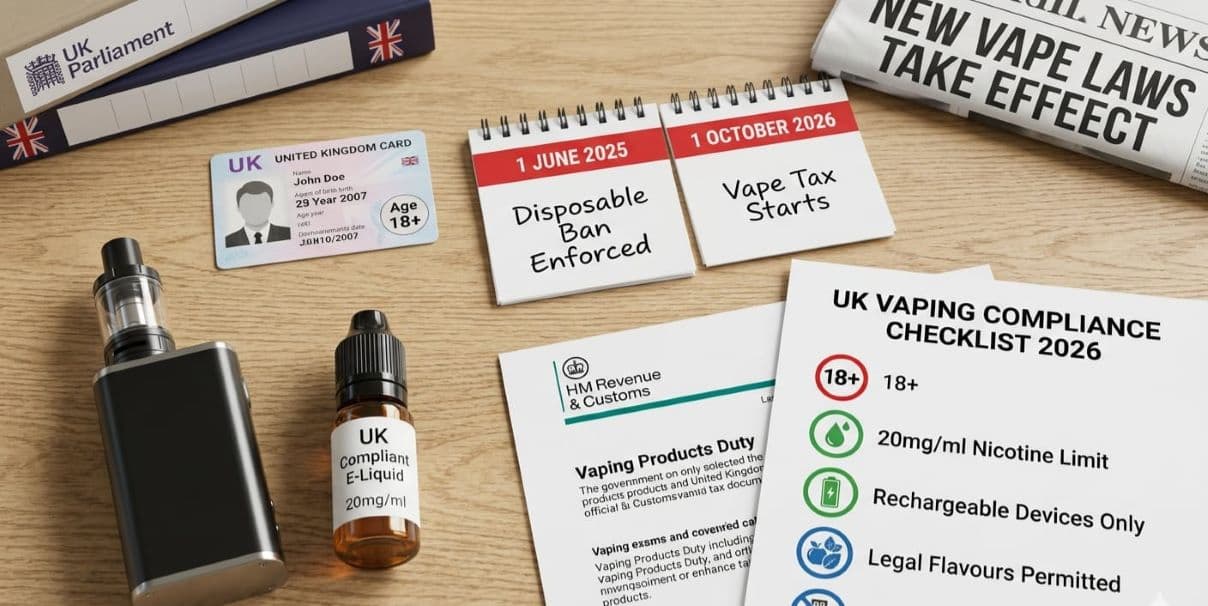
- Age limit is 18
All vaping products require age 18+ to purchase. Challenge 25 is standard retail practice.
- Disposable vapes are banned
Single-use disposables have been illegal to sell or supply across the UK since 1 June 2025. Rechargeable devices with swappable pods remain fully legal.
- Nicotine capped at 20mg/ml
No product above this concentration can be legally sold through UK retail channels. All TRPR-compliant products must be MHRA-notified.
- Vape tax from October 2026
£2.20 per 10ml of e-liquid (+VAT), applying to all liquid formats. Hardware is not taxed.
- All flavours are currently legal
Fruit, menthol, dessert, and candy flavours all remain legal. Naming restrictions may follow through secondary legislation but are not yet confirmed.
- No national indoor vaping ban
Venues set their own rules. Most hospitality and public transport operators prohibit vaping indoors.
- Generational tobacco ban confirmed
Born on or after 1 January 2009? No tobacco products, ever. Vaping retains standard 18+ access regardless of birth year.