



















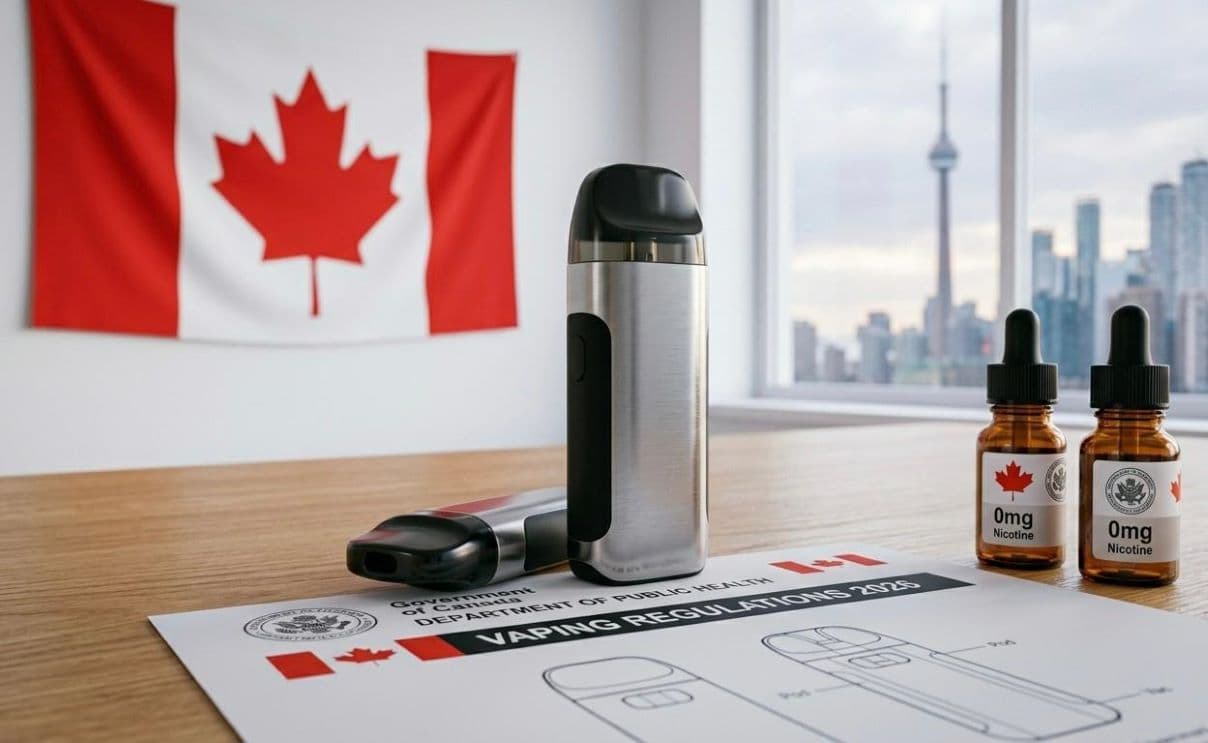
Canada's vaping regulatory system in 2026 is unlike any other country covered in this series. It is not a single national law — it is a two-layer structure where federal legislation sets a national floor and every province builds its own rules on top of it. Where you live in Canada determines which flavours you can buy, where you can buy them, what age you must be, and whether online orders from the next province are even legal to deliver to your door.
The result is a genuinely fragmented market where a product legally on the shelf in Alberta cannot be sold in Quebec, a teenager who cannot buy a vape in Ontario could legally buy one in Alberta, and a flavour available at a Vancouver vape shop may be banned in a New Brunswick convenience store. This guide explains the federal baseline and then breaks down the provincial differences that actually determine what you can buy, where, and at what age. For comparison with other major vaping markets, read our Vaping Laws in Japan 2026 and Vaping Laws in the United States 2026 guides.
The Federal Foundation: TVPA Sets the National Floor
Canada's Tobacco and Vaping Products Act (TVPA) is the national foundation. Everything a province does sits on top of it — provinces can be stricter but not looser than federal rules. The TVPA establishes five core national standards that apply in every province and territory without exception.
1. Nicotine Cap: 20mg/ml Nationwide
In 2026, the legal retail nicotine concentration for consumer products remains capped at 20mg/ml. This is strictly enforced across all provinces. Products exceeding this limit cannot be legally manufactured, imported, or sold anywhere in Canada. This matches the EU and UK standard but is significantly lower than the 50mg (5%) salt nicotine products widely available in the United States and imported into South Korea.
For vapers familiar with 50mg salt nicotine e-liquids, this is the most immediately significant restriction. The maximum legally available product strength in Canada is 20mg/ml — effective for many users but notably lower than international high-strength options.
2. Minimum Purchase Age: 18 Federally, But Provinces Go Higher
It is illegal to sell or provide vaping products to anyone under the age of 18 at the federal level. Many provinces, including Ontario, set the minimum age higher at 19. The 18-or-19 divide is one of the most practically confusing elements of Canadian vaping law for consumers who travel between provinces.
3. Mandatory Health Warning Packaging
All products must feature standardized health warnings and child-resistant containers (CRC). Packaging and labelling standards are federal — every legally sold product in Canada carries standardized warnings regardless of province.
4. Advertising Restrictions
Vaping product advertising is restricted in Canada. Lifestyle advertising that could appeal to young people is prohibited, and all advertising must include health warnings. Vape products cannot be promoted in ways that associate them with a glamorous lifestyle.
5. No Federal Flavour Ban Yet
There is no nationwide federal flavour ban in Canada as of 2026. Health Canada has been reviewing the issue since 2021, with draft regulations still pending and no finalization confirmed. This is the single most important federal fact for vapers: flavours are federally permitted. Provincial bans are where the restrictions actually live.
The Province-by-Province Breakdown
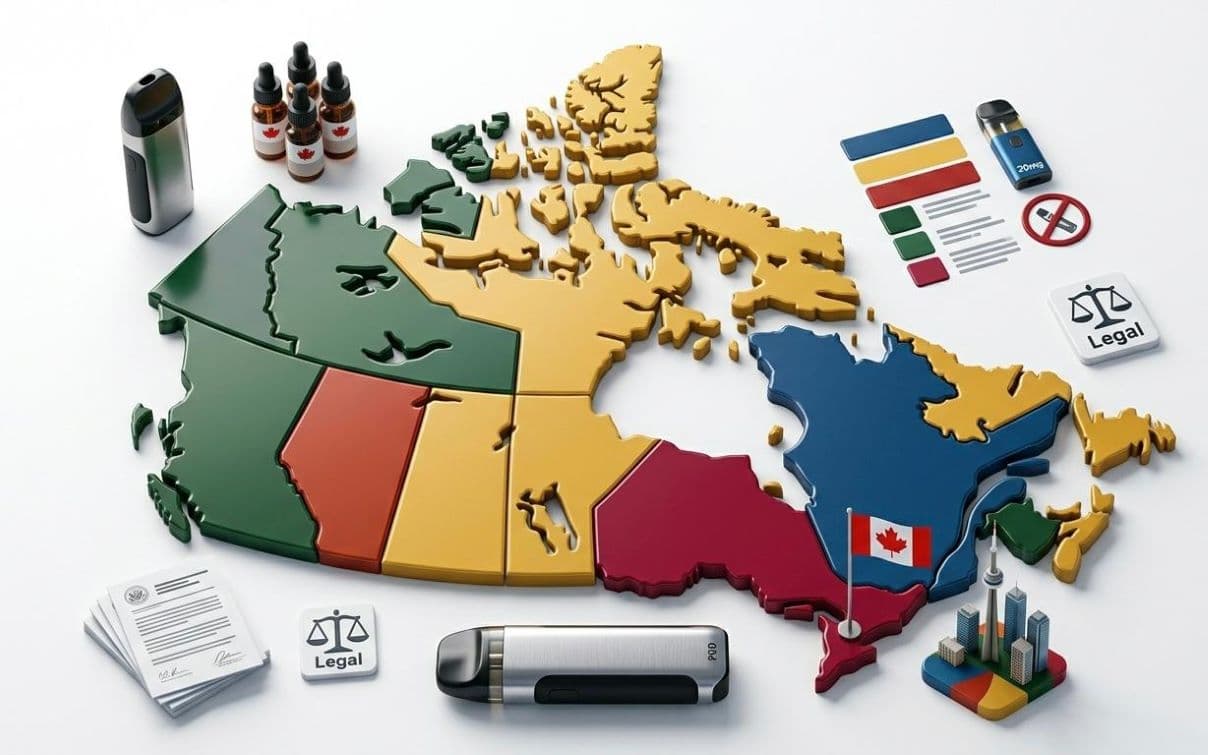
The provincial layer is where Canadian vaping law actually decides what you can buy, where, and at what age.
Quebec: Most Restrictive Province
Quebec is Canada's most restrictive vaping province by a significant margin. Quebec bans all flavoured vapes — only tobacco flavour is allowed. The minimum purchase age is 18 (matching the federal baseline). Vaping products are restricted to age-verified tobacco retailers, not general convenience stores. Quebec also restricts online sales of flavoured products: Quebec's flavour ban applies to online sales too, so a cross-provincial online order of flavoured products delivered to a Quebec address violates provincial law.
Nova Scotia, New Brunswick & Prince Edward Island: Atlantic Flavour Bans
Quebec, Nova Scotia, New Brunswick, Prince Edward Island, and the Northwest Territories have all moved ahead without federal legislation, banning the sale of most non-tobacco vaping flavours within their borders. The minimum purchase age in these Atlantic provinces is 19. Nova Scotia joined Canada's coordinated vaping products excise duty system on April 1, 2026. Under this system, eligible vape products may be subject to the standard federal vaping duty plus an additional Nova Scotia vaping duty.
Ontario: Flavours Allowed, Specialty Shop Rules Apply
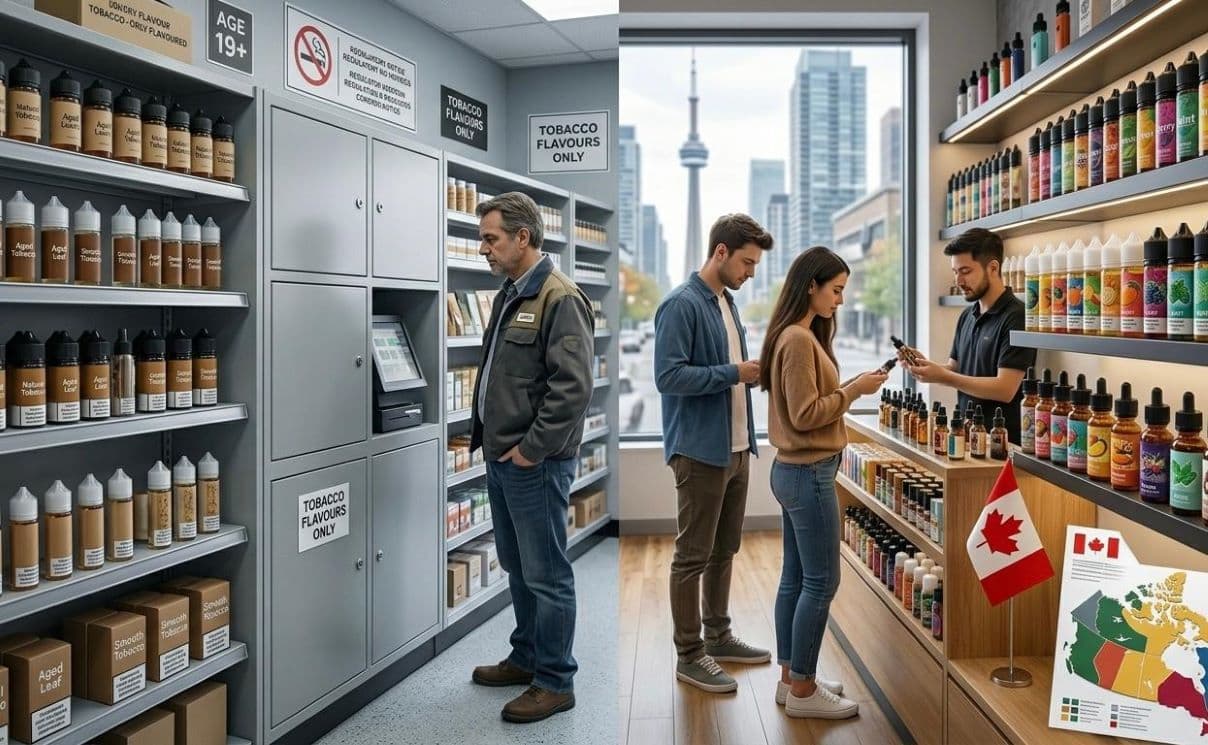
Ontario has not enacted a provincial flavour ban as of April 2026, meaning flavoured vaping products remain available for purchase. The minimum age is 19. BC, Ontario, and Saskatchewan limit flavoured products to specialty vape shops, which means convenience stores carry almost nothing of interest to flavour-focused vapers. For Ontario residents, flavoured e-liquids and devices exist — but you need to find a specialty vape shop, not a convenience store, to access them.
British Columbia: Tobacco-Only at General Retail, Specialty Shops Open
British Columbia: the age of majority is 19, and only tobacco flavours are permitted for sale in convenience and gas stores. Specialty stores do not have flavour restrictions. BC also enforces maximum container sizes: it is prohibited to sell a vaping product that exceeds 30ml in the case of a container that holds an e-substance for refilling cartridges, or 2ml in the case of a cartridge. Nicotine-free products are prohibited in BC — an unusual restriction that catches many buyers off guard.
Alberta: Most Open Major Province
The legal vaping age in Alberta is 18 — individuals must be 18 or older to purchase vape products. There is no provincial flavour restriction. Alberta is the most open of Canada's major provinces for vaping: 18 minimum age, no provincial flavour ban, and the widest retail availability. A disposable or flavoured pod banned in Quebec may sit legally on an Alberta shelf.
Saskatchewan and Manitoba: Middle Ground
Saskatchewan follows a similar pattern to Ontario — flavours exist but access is channelled through specialty vape shops rather than general retail. Manitoba's minimum age is 19. Neither province has enacted a full flavour ban as of mid-2026, though restrictions on where flavoured products can be displayed and promoted apply.
The Flavour Situation: Divided Nation
Federal hesitation has left Canada with a starkly divided regulatory landscape. In the absence of a national standard, several provinces and territories — including Quebec, New Brunswick, Nova Scotia, and Prince Edward Island — have moved forward with their own total flavour bans. Meanwhile, Ontario and British Columbia continue to allow fruit and dessert flavours, provided they are sold within the controlled, age-restricted environment of specialty vape shops.
The practical impact: Nova Scotia, Quebec, PEI, and New Brunswick have flavour bans that strip most e-juice from physical shelves entirely. If you live in these provinces, the range of products legally available locally is extremely narrow.
The national flavour ban remains pending. The "upcoming" national ban remains a theoretical goal for public health advocates rather than a confirmed legal reality, leaving both the industry and consumers in a state of perpetual uncertainty. As of mid-2026, there is no confirmed timeline for federal flavour regulations.
Online Sales: Legal But Provincial Rules Still Apply
Online retailers operate under the same legal obligations as any physical vape retailer in Canada: age verification at checkout, compliance with federal nicotine regulations, and proper product labelling. Ordering online doesn't bypass provincial law — it simply provides access to the range of federally compliant products that may not be stocked at the nearest convenience store.
This is the detail most online shoppers miss. A flavoured product legally sold by an Ontario retailer cannot be legally shipped to a Quebec or Nova Scotia address. Provincial flavour bans apply to online orders destined for those provinces, not just to physical retail. Age verification at checkout and on delivery is mandatory for all online vape sales across Canada.
The Excise Duty System: Canada's Vape Tax
Canada operates a federal excise duty on vaping products — a per-unit tax applied at the manufacturer or import stage. Provinces can add their own duty on top of the federal rate. Nova Scotia joined Canada's coordinated vaping products excise duty system on April 1, 2026, making vape products subject to the standard federal vaping duty plus an additional Nova Scotia vaping duty.
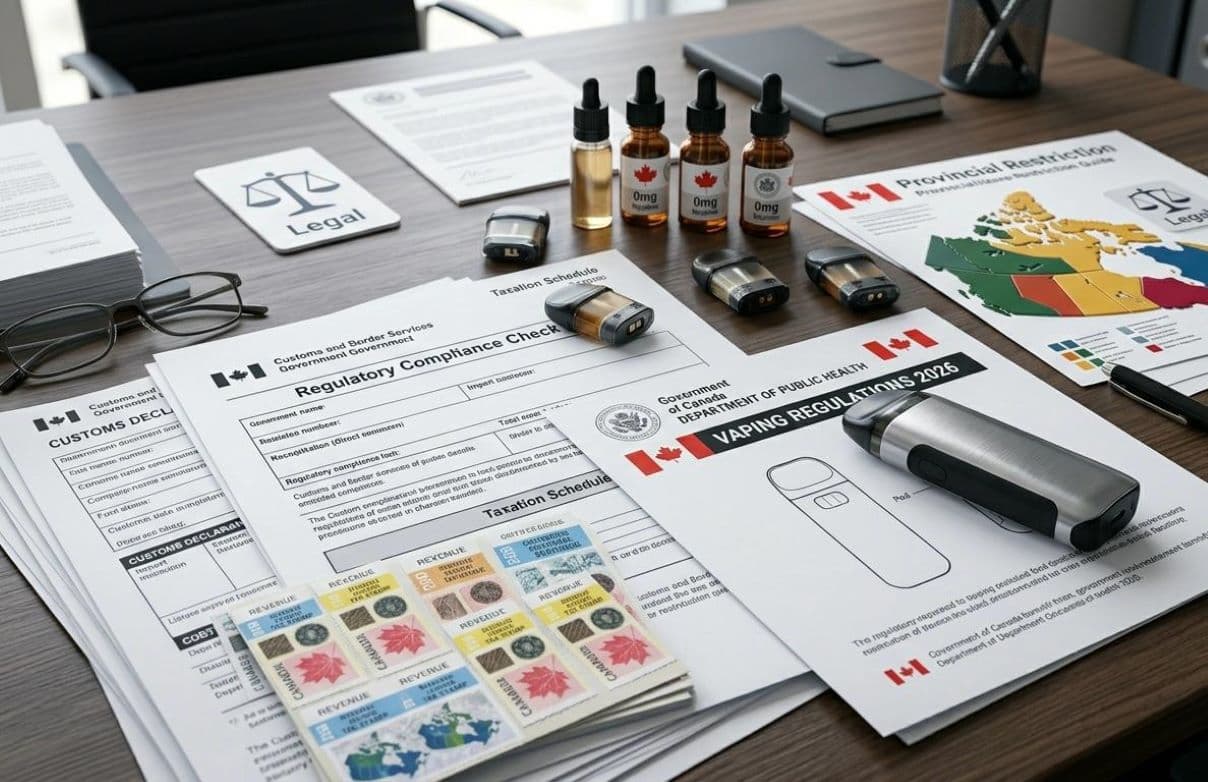
Any product imported for sale must feature the correct CRA excise stamp for the province of destination. Products without the correct provincial excise stamp cannot be legally sold in that province regardless of their federal compliance status. This stamp system is one of the primary compliance points for importers and retailers dealing across provincial lines.
Where You Can Vape in Canada
Vaping is legal for adults in Canada, but its use is heavily restricted. Expect it to be banned in all indoor public spaces and workplaces. Outdoor use is often restricted near entrances, schools, and playgrounds. Municipal rules in Toronto, Vancouver, and Montreal often add an extra layer of bans for beaches and parks — always look for local signage.
Indoor Rules
Almost universally banned indoors in public spaces. All restaurants, cafes, bars, workplaces, shopping malls, transit, and government buildings prohibit indoor vaping across all provinces. No Canadian province has exempted vaping from indoor restrictions.
Outdoor Rules
The outdoor buffer zones around entrances and playgrounds range from 4 to 20 metres depending on where you are. Every province sets its own buffer zone distance from building entrances — check local signage before vaping near any public building. Municipal layers add further restrictions in major cities. Vaping on Toronto beaches, Vancouver parks, and Montreal public squares may face additional local rules not covered by provincial legislation.
Designated Smoking Areas
Where smoking is permitted, vaping is generally also permitted unless specific signage prohibits it. Designated outdoor smoking areas at workplaces and entertainment venues typically apply to vaping as well.
Key Canada Vaping Law Facts at a Glance
A quick reference for what actually decides what you can buy, sell, or use in Canada in 2026.
Key Facts at a Glance
- Vaping is legal for adults across Canada
No province or territory has banned vaping outright. The product category is legal everywhere with varying restrictions.
- National nicotine cap: 20mg/ml
Applies in every province. No product above this concentration can be legally sold anywhere in Canada. Matches EU and UK standards.
- Age limit is 18 federally, 19 in most provinces
Federal minimum is 18. Ontario, BC, Nova Scotia, New Brunswick, PEI, Saskatchewan, Manitoba, and most territories set 19. Alberta and Quebec apply 18.
- No federal flavour ban, but provincial bans exist
Quebec, Nova Scotia, New Brunswick, PEI, and the Northwest Territories ban most flavours. Ontario and BC channel flavours to specialty shops only. Alberta has no provincial flavour restriction.
- Online sales are legal with age verification
Compliant online retailers can sell to adults across Canada with age verification at checkout and delivery. Provincial flavour bans still apply to online orders destined for restricted provinces.
- Excise duty applies nationally
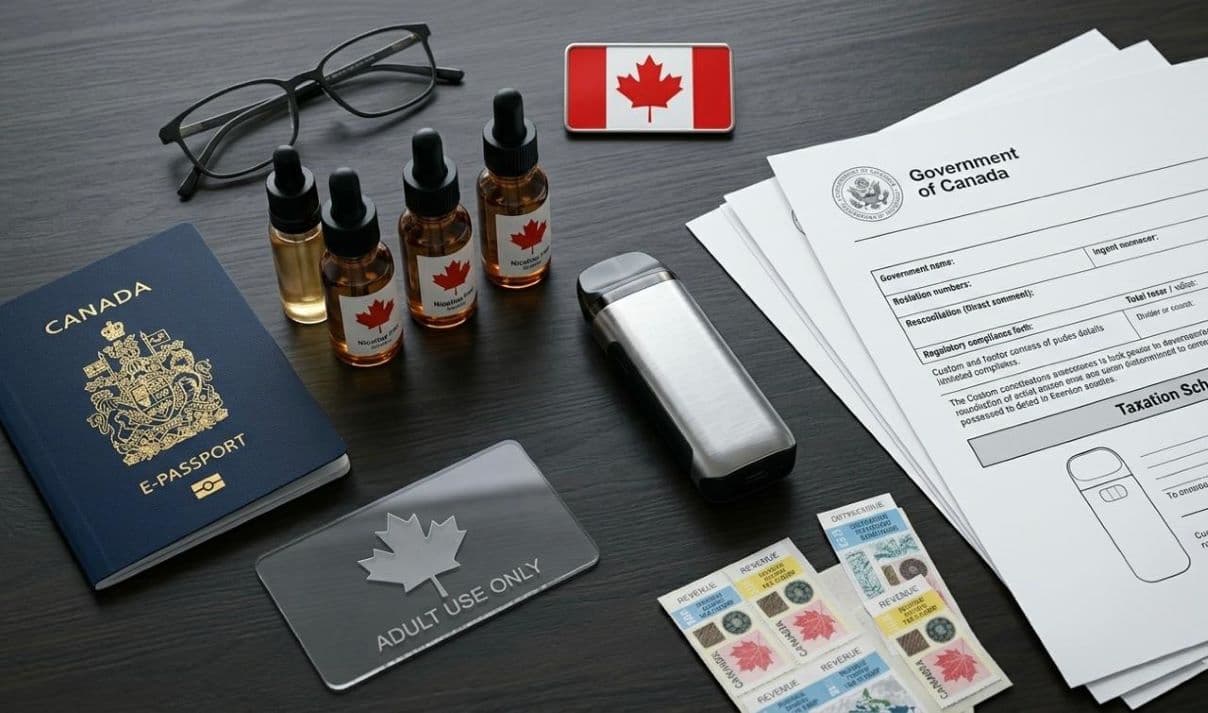
Federal duty plus provincial additions in some provinces. All legally imported and sold products must carry the correct provincial CRA excise stamp.
- Indoor vaping banned across Canada
All indoor public spaces, workplaces, and transit are smoke-free and vape-free. No provincial exception exists.
- Outdoor vaping generally permitted
Subject to building entrance buffer zones (4–20 metres by province) and municipal restrictions in major cities.